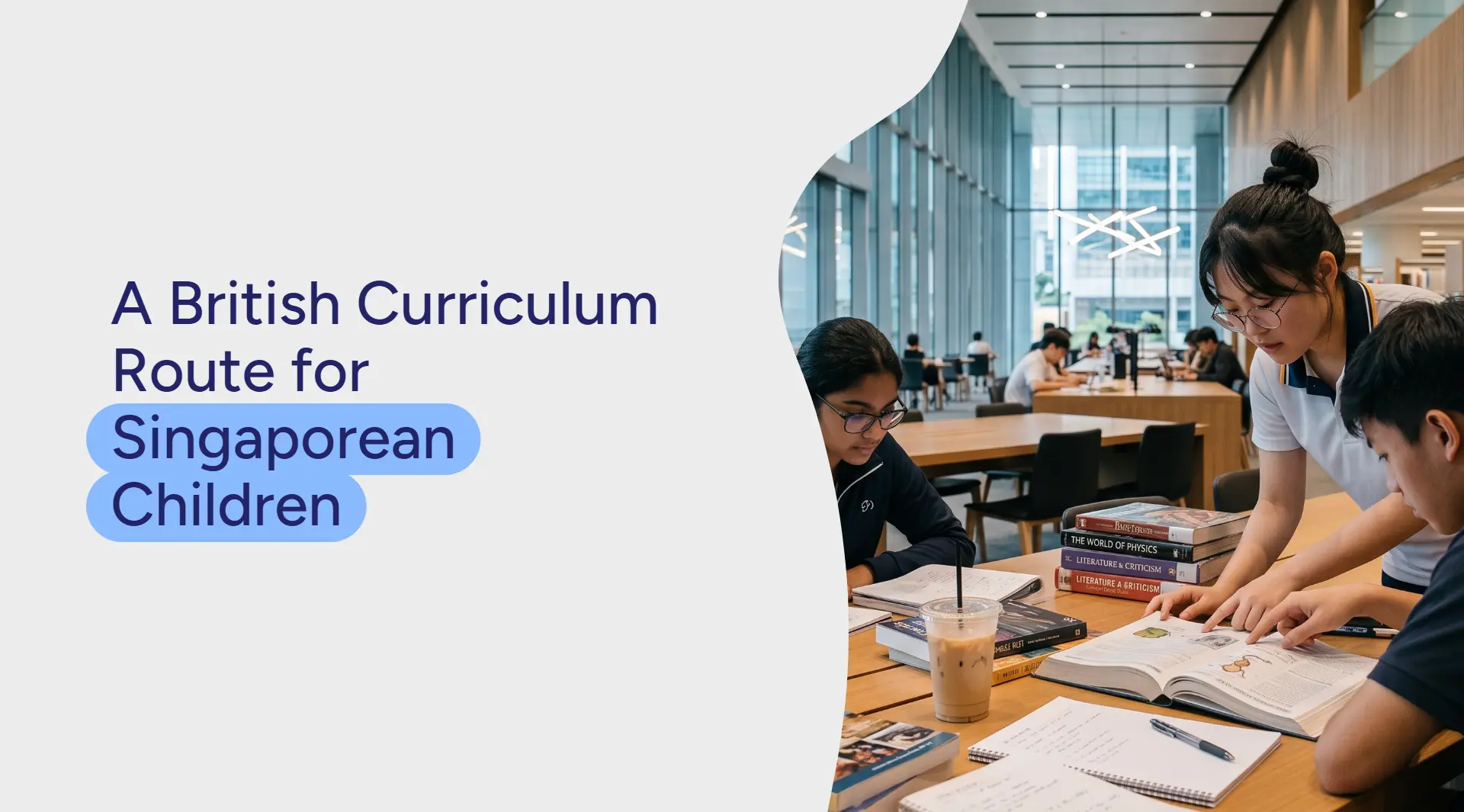
A British Curriculum Route for Singaporean Children
There are two completely different answers to “can a Singaporean child follow the British curriculum online,” and which one applies depends on the child’s age and citizenship. For expatriate and permanent-resident families, enrolment is direct — no MOE approval, no exemption, the same process as a family in London or Sydney. For Singapore Citizen families with a primary-age child, the Compulsory Education Act applies: MOE exemption is required, the child must sit the PSLE at benchmark level as a condition of that exemption, and the approved learning plan must include Mother Tongue Language. For Singapore Citizens of secondary age, none of this applies and enrolment is direct. Understanding which position you are in saves months of uncertainty.
Singaporean Citizen families choosing the British International route must navigate MOE Compulsory Education Exemption, the PSLE benchmark requirement, and the Mother Tongue Language expectation — none of which apply to expatriate or permanent-resident families. The pathway is available but with specific regulatory conditions at primary school level.
The British International pathway is straightforwardly available to expatriate families in Singapore — no MOE approval, no exemption process, direct enrolment. For local Singaporean families, the same pathway exists but with meaningful regulatory friction at primary school level. Understanding these specifics upfront saves families months of uncertainty and helps decide whether the trade-offs work for the specific family.
British curriculum for a Singaporean child: what's different
The three distinctive requirements for Singapore Citizen families that don't apply to expats:
Compulsory Education Act 2000 (Cap. 51). All Singapore Citizens born after 1 January 1996 living in Singapore must attend a national primary school unless MOE grants exemption. Only primary-age children are affected; secondary-age children are outside the CEA.
MOE Compulsory Education Exemption process. To enrol a Singapore Citizen primary-age child in an online British International school (or homeschool arrangement), the family must apply to MOE's Compulsory Education Unit for exemption. Applications typically submitted July to October before Primary 1 enrollment.
PSLE benchmark requirement. Singapore Citizens on approved exemption arrangements must sit the Primary School Leaving Examination (PSLE) at a benchmark level as a condition of the exemption. This includes the Mother Tongue Language paper.
Mother Tongue Language expectation. The MOE-approved learning plan for a Singapore Citizen child under CE exemption must include Mother Tongue Language (Chinese, Malay, Tamil, or a non-Tamil Indian language) alongside English Language, Mathematics, and Science.
Read Teneo's homeschooling in Singapore guide for the detailed process. Contact Teneo International School.
An alternative to local school for a Singaporean child
For Singaporean families considering the British International pathway, the practical reasons that drive the decision:
Global portability of the qualifications. International GCSEs and A Levels open direct admission to UK, US, Australian, Canadian, European and Singaporean universities. A child anticipating university outside Singapore benefits from the qualifications global universities were built around.
Removal of PSLE-and-Posting-Group pressure. Even with the shift to Full Subject-Based Banding from 2024, PSLE and Sec 1 Posting Group assignment remain sorting mechanisms with real social and academic weight. The British curriculum removes the PSLE variable entirely for internal school progression (though homeschooled Singapore Citizens still sit PSLE at benchmark).
Subject-level flexibility from earlier ages. The British curriculum allows subject-level differentiation from primary onwards; local school Full SBB introduces this from Sec 1.
Different pedagogical style. British International curriculum emphasises written argument, essay-based assessment, and coursework alongside terminal examinations. Local Singapore system emphasises examination performance and structured content mastery. Different children thrive under different approaches.
Family circumstances. Diplomatic and business families with international careers may prefer the British International route for continuity across future moves. Families with specific values around examination pressure may prefer the different rhythm.
British education for locals in Singapore: the regulatory path
The practical process for a Singapore Citizen family:
Step 1: Assess whether Compulsory Education applies to your child. If your child is Singapore Citizen and of primary school age (broadly 6–12), CE applies. If your child is secondary school age, CE does not apply and no MOE exemption is required.
Step 2: If CE applies, apply for exemption. Applications to MOE's Compulsory Education Unit typically submitted between July and October in the year before Primary 1 entry. The application requires a learning plan covering the four core subjects (English Language, Mother Tongue, Mathematics, Science) and demonstrates that the objectives of compulsory education will be met.
Step 3: Enrol at the online British International school. Enrolment can proceed once exemption is confirmed. Some families enrol conditionally while exemption is being processed; some wait for confirmation. Confirm process with the specific school.
Step 4: Plan for PSLE benchmark. The child will need to sit the PSLE (or accepted equivalent, subject to MOE's specific conditions) at benchmark level as a condition of the exemption. This means preparing for both the British curriculum and the PSLE assessment approach.
Step 5: Integrate Mother Tongue Language study. Under exemption, the approved plan must include Mother Tongue. For Mandarin-speaking families, this can be through Pearson Edexcel International GCSE Chinese (specification 4CN1) later in the pathway; earlier years can be through community classes or supplementary tuition. Malay and Tamil are taken through SEAB separately.
Step 6: For secondary-age children, no exemption needed. Secondary-age Singapore Citizens can enrol at an online British International school without MOE approval. The pathway is direct.
What Singaporean Citizen families should think through
Being direct about the trade-offs specific to Citizen families:
In favour:
International qualification portability, particularly for families with global career trajectories.
Removal of PSLE Posting Group pressure at the entry point to secondary.
Different pedagogical approach that may suit some children better.
Potential international university pathway with fewer bridging requirements.
Against or complicating:
MOE Compulsory Education Exemption process adds friction and uncertainty at primary level.
PSLE benchmark requirement means preparing for both curricula in parallel.
Mother Tongue expectation adds a stream (though this can be integrated).
The Singapore national education system is genuinely excellent — the trade-off requires thinking about what specifically doesn't work rather than assuming the alternative is better.
NUS, NTU, SMU may particularly value the local qualifications for scholarships and specialist programmes designed around them.
Community and identity considerations — the Singapore school system is a formative shared national experience.
Not affected either way:
The child's Singapore Citizenship, NS obligations (for boys), and eligibility for national programmes remain unchanged.
CPF, healthcare and other Citizen benefits are unaffected by school choice.
Educational choices at university level remain fully open regardless of secondary school choice.
For permanent-resident and expatriate families
Permanent-resident families' children are generally not subject to the Compulsory Education Act (the Act applies specifically to Singapore Citizens), though family-specific circumstances should be confirmed with MOE. Expatriate families on Employment or Dependant Passes are outside the CEA and can enrol children in an online British International school directly, with no MOE approval required.
For these families, the British International pathway is straightforward — enrolment happens the same way as for a family in London or Sydney. The regulatory considerations above apply only to Singapore Citizens.
Frequently asked questions
Can Singaporean citizens study the British curriculum online?
Yes, with regulatory considerations. Singapore Citizens at primary school age (broadly 6–12) require MOE Compulsory Education Exemption to enrol at an online British International school; applications submitted July to October before Primary 1 entry. The child must sit the PSLE at benchmark level as an exemption condition. Secondary-age Singapore Citizens can enrol without MOE approval.
What is an alternative to a local school for a Singaporean child?
The British International pathway (online or in-person international schools), the American International School curriculum, IB curriculum (available at several Singapore international schools), or homeschooling. Each has different regulatory implications for Singapore Citizens, with online British schools requiring Compulsory Education Exemption at primary level but not at secondary.
Can Singapore citizens attend an online British school?
At secondary school age, yes — directly, with no MOE approval required. At primary school age, yes — subject to MOE Compulsory Education Exemption approval. The pathway is genuinely available; the process is more involved than for expatriate families.
What is British education for locals in Singapore?
British International curriculum (Pearson Edexcel International GCSEs and A Levels) offered by online and in-person British International schools in Singapore, taught in English, leading to internationally recognised qualifications. For Singapore Citizens at primary school age, the enrolment route requires MOE Compulsory Education Exemption.
Does a Singapore Citizen still have to sit the PSLE if enrolled at a British International school?
For Citizens enrolled at an online British International school under Compulsory Education Exemption, yes — the child must sit the PSLE (or accepted equivalent) at benchmark level as a condition of the exemption, including the Mother Tongue Language paper. For Citizens enrolled at MOE-registered in-person Foreign System Schools (international schools) under waivers, the specific PSLE requirements depend on the individual waiver conditions.
Do I need MOE approval for a permanent resident child?
Permanent-resident children are generally not subject to the Compulsory Education Act in the same way Singapore Citizens are; family-specific circumstances should be confirmed with MOE. In most cases, PR families can enrol at online British International schools without a formal exemption.
What about Mother Tongue Language for a Citizen child?
Under Compulsory Education Exemption, the approved learning plan must include Mother Tongue Language. For Mandarin-speaking families, this integrates well with the British curriculum through Pearson Edexcel International GCSE Chinese. For Malay- and Tamil-speaking families, this is taken separately through SEAB alongside the British academic subjects.
For Singapore Citizen families, the British International pathway is available but with genuine regulatory conditions at primary school level. Understanding the CE exemption process, PSLE benchmark, and mother-tongue expectation upfront helps decide whether the trade-offs work. For secondary-age Citizens, the pathway is direct with no MOE approval required.
Share
