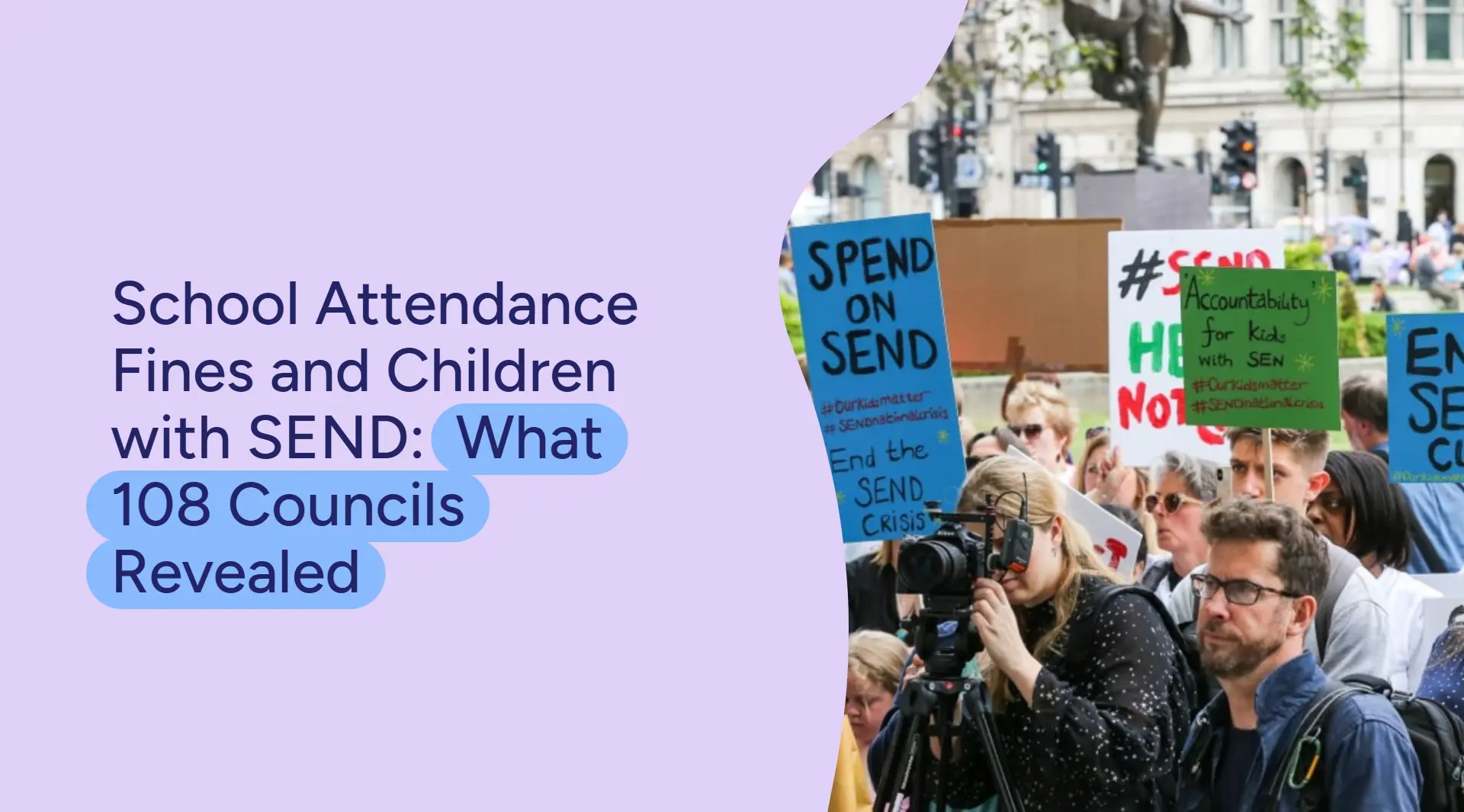
School Attendance Fines and Children with SEND: What 108 Councils Revealed
Between June and September 2026, Teneo International School asked every English and Welsh local authority four questions about school attendance penalty notices. The questions were simple. Does the council record why a fine was issued? Does it know whether the child had a medical condition, mental-health need, or was experiencing emotionally based school avoidance (EBSA)? How many fines went to families of children with SEN Support or an Education, Health and Care Plan? And does the council have a specific policy covering these children?
A Teneo International School FOI investigation of 108 English and Welsh councils found 33,061 attendance penalty notices issued over two years to families of children with SEND, against 203,908 fines in total. In councils counting the full SEND cohort, those children account for 17–23% of all attendance fines. SEND-linked fines rose in 15 councils.
One hundred and eight councils responded. The answers reveal a system that, in most places, is not counting the thing that matters most.
What the investigation asked
Each council received an identical four-question Freedom of Information request:
Q1: Is the reason for absence recorded at the point a penalty notice is issued, and in what categories?
Q2: Does the council hold data on penalty notices issued where the child had a recorded medical condition, mental-health need, or was recorded as experiencing anxiety or EBSA?
Q3: How many penalty notices were issued in 2023/24 and 2024/25 to families where the child was on SEN Support, and where the child had an EHCP?
Q4: Does the council operate a specific policy covering penalty notices where the child has SEND or a mental-health need?
Aggregate numbers only. No personal data, no identification of individual children, families or schools.
Headline findings
Scale:
108 councils responded across England and Wales.
203,908 penalty notices issued in total across the two years by councils providing total figures (104,416 in 2023/24; 99,492 in 2024/25).
33,061 penalty notices issued to families of children with SEND across the same two years (15,541 in 2023/24; 17,520 in 2024/25) — a 12.7% year-on-year rise.
6,923 penalty notices issued to families of children with an EHCP specifically (3,040 then 3,883) — a 27.7% year-on-year rise, sharper than the overall SEND rise.
The counting gap:
Only one council of 108 could put a number on penalty notices issued where the child had a recorded medical condition, mental-health need or EBSA.
12 councils deployed a defensive framing in place of data: "if the absence were medically related it would be authorised, so no fine would be issued."
9 councils refused Q2 or Q3 on Section 12 cost grounds.
83 of 108 councils have no specific policy covering penalty notices where the child has SEND or a mental-health need.
24 councils do not record the reason for absence at the point of issuing a fine at all.
The ratio finding:
In the 14 councils that provided both total penalty notices and SEND-linked penalty notices, SEND children account for between 0.2% and 23% of all fines.
Among the councils that record SEN Support as well as EHCP — the ones counting properly — the ratio clusters between 16.4% and 23.0%.
Councils recording EHCP only, without SEN Support, report ratios of 1–5% — which is a recording artefact, not a lower rate.
The escalation finding:
15 councils recorded double-digit year-on-year rises in SEND-linked penalty notices.
Sharpest: Sutton +173%, Tower Hamlets +118%, Redcar and Cleveland +110%, Hounslow +80%, Halton +76%, Stockport +51%, Oxfordshire +41%, Surrey +40%, Plymouth +38%, Liverpool +34%, Southampton +33%.
EHCP-only rises are consistently sharper than combined SEND rises: Hounslow EHCP +183%, Sutton +173%, Halton +135%, Redcar and Cleveland +110%, Stockport +80%, Liverpool +71%, Southampton +46%.
The single most important data point: Hounslow
Of 108 councils asked whether they hold data on penalty notices issued where the child had a recorded medical condition, mental-health need, or EBSA, one council produced a number.
London Borough of Hounslow: 24 penalty notices in 2023/24, rising to 42 in 2024/25 — a 75% year-on-year increase.
This matters more than any other single figure in the investigation, for one reason. Twelve councils responded to the same question with a variant of the same defensive framing: if a child's absence were down to a medical condition or mental-health need, the school would record it as authorised, and therefore no penalty notice would be issued.
Hounslow's numbers show that framing does not hold. Children with recorded medical conditions, mental-health needs and EBSA are being fined — at least in the one borough that counts it and discloses it. Hounslow is not an outlier council; it is the only council in the sample that can answer the question at all.
Hounslow also recorded the sharpest EHCP-specific rise in the entire dataset: penalty notices to families of children with an EHCP rose from 23 to 65 — up 183% in a single year, alongside a 80% rise in total SEND-linked fines (172 → 309).
The defensive framing: 12 councils, no data
Twelve councils responded to the medical/mental-health/EBSA question not with a number, but with an assertion about how the system is supposed to work. Representative examples, in the councils' own words:
Bradford: "Where absence is recorded by the school due to a genuine illness / medical reason, whether due to a physical or mental health need, this will be recorded as authorised… therefore a penalty notice would not be issued."
Brighton and Hove: "If a school records a pupil's absence as due to illness, no FPN is issued in connection with that absence."
North Tyneside: "We do not issue penalty notices for children that have a medical condition, mental health need or EBSA. These children would be recorded on the register with an I code (authorised absence)."
Calderdale: "A penalty notice would not be issued where the child had a medical condition, a mental health need, or experiencing anxiety or EBSA unless there were other circumstances relating to the period of absence."
Torbay: "We do not issue penalty notices where absence is due to medical need."
Buckinghamshire: "Where medical conditions, mental health needs or EBSA are identified as the primary cause of absence, enforcement action would not normally be considered appropriate."
Each statement describes the intended operation of the system. None is evidence about what actually happened. The structure of the claim is circular: the council does not record the data because it believes the circumstance cannot arise, and cites the belief as the reason no data exists.
Hounslow's 42 fines in a single year demonstrate the circumstance does arise.
Two councils gave a positively-confirmed zero rather than a defensive assertion — Trafford ("0", recorded and checked) and Peterborough ("None — we would not expect or authorise a fixed penalty notice where this was listed as the reason"). These are evidentially different from the defensive framings: a recorded zero is a measurement; an assertion that fines "would not be issued" is not.
Lambeth offered the strongest version of the claim — "no fixed penalty notice has or would be issued" where a child has a recorded medical, mental-health or EBSA condition — while also stating it does not hold SEND status data at all. The council cannot substantiate the claim it is making.
What the councils that count properly actually found
Fourteen councils provided both total penalty notice figures and SEND-linked figures, allowing a clean ratio. The results, as a percentage of all penalty notices issued to families of children with SEND:
Southend-on-Sea: 17.1% (2023/24) → 23.0% (2024/25)
Solihull: 20.4% → 21.2%
North Yorkshire: 19.0% → 20.8%
Essex: 19.0% → 18.9%
Central Bedfordshire: 16.4% → 17.5%
Wakefield: 16.8% → 17.3%
West Sussex: 13.3% → 16.8%
Surrey: 5.0% → 5.8%
Cheshire East: 4.7% → 4.0%
Merton: 3.7% → 3.2%
Brighton and Hove: 3.0% → 3.6%
Sutton: 1.0% → 2.3%
Nottinghamshire: 1.0% → 1.3%
Hillingdon: 0.9% → 0.2%
The distribution splits cleanly into two groups, and the split is explained by recording practice rather than by local variation in enforcement.
The seven councils reporting 16–23% — Southend, Solihull, North Yorkshire, Essex, Central Bedfordshire, Wakefield, West Sussex — all record both SEN Support and EHCP status. They are counting the full SEND cohort.
The seven councils reporting 0.2–5.8% — Surrey, Cheshire East, Merton, Brighton and Hove, Sutton, Nottinghamshire, Hillingdon — record EHCP only, or hold only fragmentary SEN Support data. Nottinghamshire states explicitly that it "only holds EHCP data from 2023/24 onwards; SEN Support intersection not held." Merton "does not record SEN Support."
Since children on SEN Support outnumber children with an EHCP by roughly four to one nationally, a council counting EHCP alone will report a ratio roughly a fifth the size of a council counting both. The low figures are a measurement artefact, not a lower rate of enforcement.
Taking the seven councils that count the full cohort as the reliable indicator, children with SEND account for approximately 17% to 23% of all school attendance penalty notices in those areas.
The escalation: SEND fines rising faster than fines overall
Total penalty notices across responding councils fell between the two years — from 104,416 to 99,492, a 4.7% decline. SEND-linked penalty notices went the other way, rising from 15,541 to 17,520, a 12.7% increase. EHCP-specific penalty notices rose faster still: 3,040 to 3,883, a 27.7% increase.
Fifteen councils recorded double-digit year-on-year rises in SEND-linked penalty notices:
Sutton (Cognus): 11 → 30 — +173%
Tower Hamlets: 96 → 209 — +118%
Redcar and Cleveland: 20 → 42 — +110%
Hounslow: 172 → 309 — +80%
Halton: 159 → 279 — +76%
Stockport: 412 → 620 — +51%
Oxfordshire: 430 → 607 — +41%
Surrey: 226 → 316 — +40%
Plymouth: 21 → 29 — +38%
Liverpool: 818 → 1,093 — +34%
Southampton: 459 → 611 — +33%
Trafford: 229 → 281 — +23%
Merton: 11 → 13 — +18%
Buckinghamshire: 81 → 90 — +11%
Manchester: 1,908 → 2,114 — +11%
The rises span six English regions — London, North West, North East, South East, South West, and West Midlands — rather than clustering in any single area.
The EHCP pattern is sharper still
Where councils broke out EHCP figures separately, the rises were consistently steeper than the combined SEND rises in the same council:
Hounslow: EHCP 23 → 65 — +183% (vs +80% combined SEND)
Sutton: EHCP 11 → 30 — +173%
Halton: EHCP 23 → 54 — +135% (vs +76% combined)
Redcar and Cleveland: EHCP 20 → 42 — +110%
Stockport: EHCP 70 → 126 — +80% (vs +51% combined)
Liverpool: EHCP 149 → 255 — +71% (vs +34% combined)
Southampton: EHCP 65 → 95 — +46% (vs +33% combined)
Surrey: EHCP 226 → 316 — +40%
Central Bedfordshire: EHCP 89 → 117 — +32%
Manchester: EHCP 489 → 617 — +26%
Solihull: EHCP 71 → 85 — +20%
An EHCP is the highest tier of statutory special educational needs provision in England. It is a legally binding document specifying a child's needs and the support the local authority must provide. In eleven councils, fines to families of children holding that document rose year on year, in several cases by more than the increase in fines to the broader SEND cohort.
Councils where EHCP-linked fines fell: Cheshire East (−74%), Hillingdon (−86%), Walsall (−28%), Brighton and Hove (−22%), Bolton (−15%), Essex (−13%), Wakefield (−9%), Nottinghamshire (−6%), West Sussex (−5%), Torbay (−5%).
The biggest issuers
Councils issuing the highest total volumes of penalty notices across the two years:
Essex: 13,266 (2023/24) → 11,518 (2024/25) — 24,784 across two years, the highest in the sample
Bradford: 12,366 → 10,475 — 22,841
Nottinghamshire: 10,542 → 7,939 — 18,481
West Sussex: 7,998 → 6,049 — 14,047
Wakefield: 7,962 → 6,058 — 14,020
Surrey: 4,551 → 5,462 — 10,013
Luton: 4,873 → 3,620 — 8,493
Swindon: 3,081 → 2,581 — 5,662
Devon: 3,195 → 3,569 — 6,764
North Yorkshire: 3,591 → 3,564 — 7,155
Medway: 3,246 → 2,064 — 5,310
Blackburn with Darwen: 3,131 → 2,676 — 5,807
Calderdale: 3,319 → 3,031 — 6,350
Brighton and Hove: 2,993 → 1,952 — 4,945
Councils issuing zero penalty notices across both years: Powys (Wales), City of London Corporation, and Warrington (2023/24 figure of zero).
Essex's position is notable in combination with its SEND figures. With 2,517 then 2,179 SEND-linked penalty notices, Essex issued more fines to families of children with SEND than most councils issued in total.
Section 12: nine councils refused to count
Nine councils refused the medical/mental-health or SEND breakdown questions on Section 12 cost grounds. The reasons given reveal the structural issue:
Devon: 5 minutes per referral × penalty notice volume = 297.41 hours for 2023/24 and 266.25 hours for 2024/25.
Wigan: 4,653 penalty notices × 5 minutes per record = 380 hours.
Nottinghamshire: manual checks of up to 37,343 penalty notice records plus 1,600 prosecution records.
Hertfordshire: 5–10 minutes per case × 833 total fines = 69.41 hours, with manual review requiring consultation with a separate team and system to establish SEND or EHCP status.
Barnet: 556 penalty notices × 5 minutes = 46 hours.
Derbyshire County: 500+ penalty notice records × 5 minutes = over the 18-hour limit.
Leicester City: staff would need to "trawl through various systems, SEND records, Education Welfare correspondence, education records, school correspondence."
Newcastle upon Tyne: would require manual review and creation of new information, which the Freedom of Information Act does not require.
Buckinghamshire: not routinely recorded.
Each refusal is lawful. Collectively they describe the same thing: the penalty notice system and the SEND register are held in separate systems that do not talk to each other. A council can tell you how many fines it issued. A council can tell you how many children have an EHCP. Most councils cannot tell you how many of the first group are in the second group without manually opening every file.
Eighty-three councils have no specific SEND policy
Of the 108 councils responding, 83 stated they have no specific policy covering penalty notices where the child has SEND or a mental-health need. Most cited the Department for Education's statutory guidance, Working Together to Improve School Attendance, as the framework they follow.
Twelve councils reported having some form of SEND-specific or partial policy provision. Four responded under Section 21 (information reasonably accessible by other means), pointing to published codes of conduct.
The absence of specific policy is not necessarily evidence of poor practice — statutory guidance applies regardless. But it means the decision about whether to fine the family of a child with SEND is, in most of England, a matter of local discretion exercised case by case, without a written framework specific to those circumstances, and in most cases without the data to review afterwards whether the discretion was exercised consistently.
What the investigation does not — and cannot — tell us
Being direct about the limits:
Whether individual fines were justified. The data is aggregate. It cannot assess whether any specific penalty notice was appropriate.
The national total. 108 councils responded of approximately 153 English local education authorities plus 22 Welsh. The figures in this investigation are a floor on the national picture, not the national picture itself.
Double counting. Several councils (notably Merton) flagged that where two parents are jointly responsible, each receives a separate penalty notice — so penalty notice counts exceed the number of children involved.
Whether a fine was paid, withdrawn, or escalated to prosecution. The investigation asked about issuance, not outcome.
Causation. The data shows SEND-linked fines rising in 15 councils. It does not establish why.
The medical/mental-health intersection nationally. With one council of 108 able to provide a number, no national estimate is possible on this question. That absence is itself the finding.
Methodology
Request structure. Standardised four-question FOI request sent to English and Welsh local education authorities between June and September 2026.
Reference period. Academic years 2023/24 and 2024/25.
Data treatment. Figures as released by each council, with no secondary analysis beyond addition, percentage change, and ratio calculation. Where a council flagged a caveat (double counting of joint-responsibility parents, SEN Support not held, data held from a particular year only, estimates rather than actuals), the caveat is reflected in use of that data.
Aggregation. The 203,908 total penalty notice figure and 33,061 SEND-linked figure represent the sums of councils providing those figures. Not every council provided every figure, so the two aggregates draw on overlapping but non-identical council sets. Both are floors.
Ratio calculation. The 17–23% range is drawn from the seven councils providing both total penalty notice figures and SEND figures covering both SEN Support and EHCP. Councils recording EHCP only are excluded from that range because their ratios are not comparable.
Verification. All figures are drawn from council FOI responses, each identified by FOI reference and response date in the underlying tracker. Response letters are available on request.
Full data available
The full FOI dataset — council-by-council breakdowns, FOI references, response dates, caveats, and the standardised four-question request text — is available on request to journalists, researchers, and policy organisations.
The dataset is published to be used. Journalists are welcome to quote figures with attribution to Teneo International School. Policy organisations, parent-carer forums, and academic researchers are welcome to request the underlying data for further analysis.
Commentary
Taryn Jankes, Chief Marketing Officer of Teneo International School, said:
"Across the councils that count the full SEND cohort properly, between 17% and 23% of every attendance fine goes to the family of a child with special educational needs. Total fines fell between the two years we looked at. Fines to families of children with SEND rose 13%. Fines to families of children holding an Education, Health and Care Plan — the highest tier of statutory support in the system — rose 28%.
"The more revealing finding is what councils could not tell us. We asked 108 local authorities a straightforward question: how many of these fines went to families where the child had a recorded medical condition, a mental-health need, or was experiencing emotionally based school avoidance. One council could answer. Hounslow told us 24 in one year, rising to 42 the next.
"Twelve councils answered instead with a version of the same assurance — that if the absence were medically related, the school would authorise it, so no fine would follow. Hounslow's figures show that is not what happens. The assurance is being offered in place of the data, by councils that do not hold the data that would test it.
"A child who cannot attend school because of anxiety, an unmet special educational need, or a mental-health condition is not a truancy problem. Fining that family is a policy failure before it is anything else. But the first failure is simpler than that: in most of England, nobody is counting."
Support and further information
IPSEA (Independent Provider of Special Education Advice) — free legal advice on SEND law and school attendance: ipsea.org.uk
Contact — support for families with disabled children: contact.org.uk
Not Fine In School — parent-led support for families of children experiencing school attendance difficulties: notfineinschool.co.uk
Your local parent-carer forum — statutory consultation bodies, listed via the National Network of Parent Carer Forums.
About the investigation
The investigation was conducted by Teneo International School between June and September 2026. All FOI requests were submitted through official local authority channels.
Teneo International School is a British International online school for learners aged 11 to 19, with 20,000+ learners, 4,000+ graduates, and 170+ teachers worldwide. The school's interest in this investigation reflects its focus on children whose needs are not met by mainstream school attendance models.
Share
