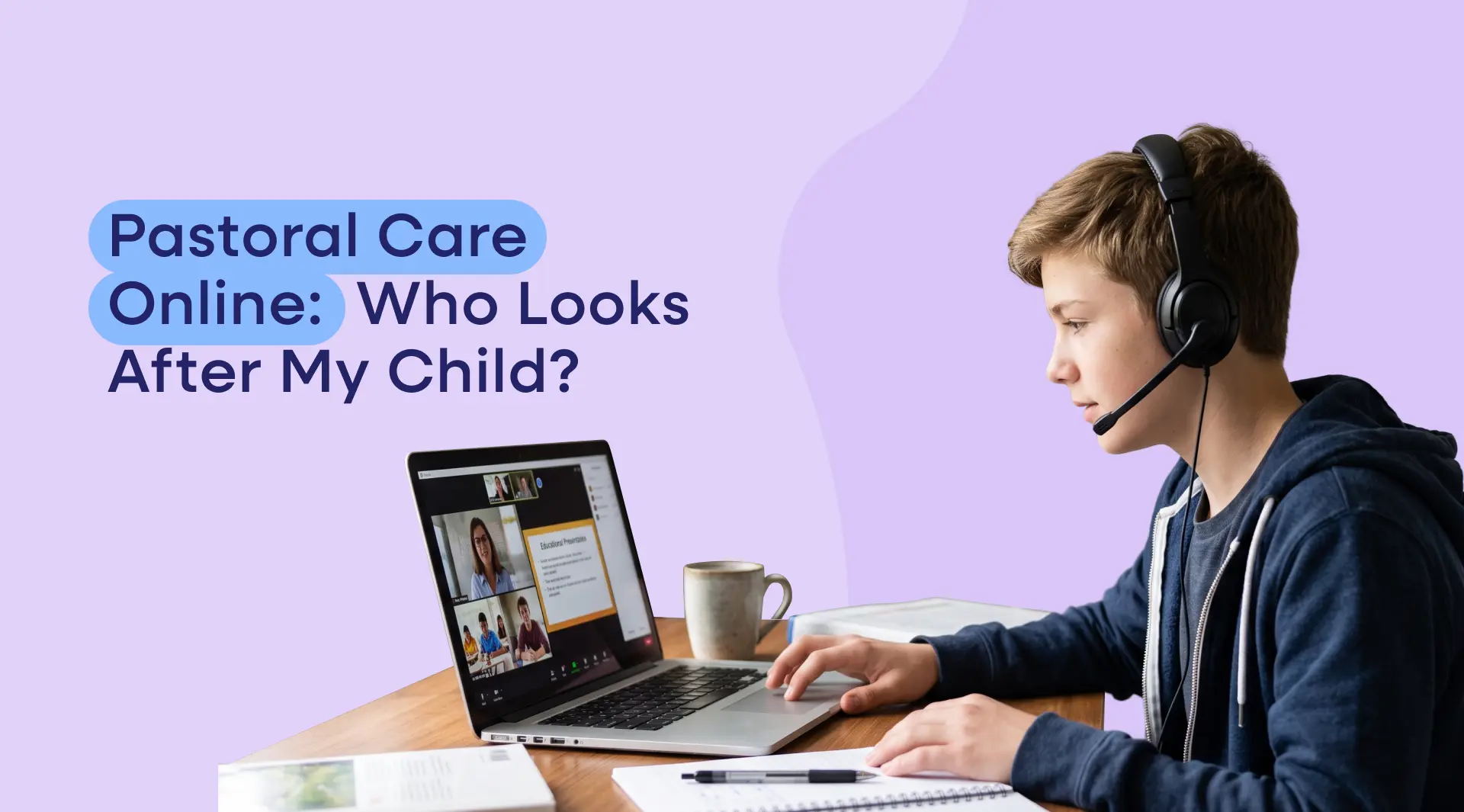
Pastoral Care Online: Who Looks After My Child?
"If there's no school building, who is actually responsible for looking after my child?" is a natural and important question — the worry that pastoral care, the human side of school, gets lost online. This guide explains how pastoral care works at a good online school, and how to find out exactly who would look after your child.
At a good online school, each student has a named pastoral contact — an identified staff member responsible for their welfare, whom the student and family can turn to. So even without a physical school, a specific adult's role is your child's wellbeing. The exact structure and check-in frequency vary by school, so confirm directly.
"If there's no school building, who is actually responsible for looking after my child?" is a natural and important question — the worry that pastoral care, the human side of school, gets lost online. This guide explains how pastoral care works at a good online school, and how to find out exactly who would look after your child.
Pastoral care at an online school: is there a named adult?
Yes — at a good online school, pastoral care is a real, structured part of the school, not an afterthought, and the key reassurance is that there is a named adult responsible for your child's welfare. This is the online equivalent of the pastoral role a physical school provides: a specific member of staff whose job includes looking out for how your child is doing, who knows them, and who the student and family can go to.
This matters because it directly addresses the underlying worry. Pastoral care is about a child being looked after as a person, not just taught subjects — someone who pays attention to their well-being, notices if something is wrong, and is a point of contact. A good online school provides this through identified pastoral staff and a named contact for each student, so your child is not just a name on a class list but someone with an adult specifically responsible for their welfare. The precise way this is structured — the exact role, title and how it operates — varies between schools, so the most useful thing is to ask a specific school exactly how its pastoral care works and who your child's named contact would be. Read how a UK online school supports mental health and wellbeing.
Do online schools have pastoral support?
Yes — a good online school has genuine pastoral support, and it is worth understanding what that includes, so you can judge a school on it. Pastoral support at a good online school typically involves:
A named point of contact for each student — an identified adult responsible for their welfare, whom the student and family can turn to.
Pastoral staff whose role is students' wellbeing, beyond subject teaching.
Small classes and known teachers, so subject teachers also know each child and notice concerns — pastoral care and teaching reinforce each other.
A route for concerns — a way for a wellbeing concern to be raised, passed to the right people, and acted on.
Contact with families — so the school and home work together on a child's wellbeing.
Together, these mean a child is looked after pastorally, not just academically. The honest point to make is that the specific structure — what the named role is called, exactly how often they check in, how the team is organised — varies from school to school, and should be confirmed with any school you are considering rather than assumed. What a good school will have, in some form, is a named adult responsible for your child and a real pastoral structure around them. Read about spotting a struggling student online.
What pastoral care actually does for your child
It helps to be concrete about what pastoral care is for, because it is the human core of what makes an online school a school rather than a set of lessons. A good pastoral structure means someone:
Knows your child as an individual, beyond their academic work.
Notices when something seems off — a change in mood, engagement or manner.
Is a point of contact the student can turn to when they need support, and the family can approach with concerns.
Coordinates support where a child needs it, connecting them with the right help within (and, where needed, beyond) the school.
Works with you as a parent, so wellbeing is a shared effort.
This is the reassurance behind the "who looks after my child?" question: at a good online school, the answer is a specific, identified adult and a pastoral structure around them, whose job is exactly that. As with any school, pastoral care supports a child's wellbeing and helps identify when more is needed — for a child with significant difficulties it works alongside professional support, not instead of it. Read whether online school is right for your child.
If your child is struggling with their mental health, please also seek support from a qualified professional such as your GP.
What to ask a school about pastoral care
Because the specifics vary, the best way to know who would look after your child is to ask directly. Useful questions:
Who would be my child's named point of contact for pastoral care, and what is their role?
How does that person keep in touch with my child, and how often?
How is a wellbeing concern raised and acted on — what is the process?
How does the school keep me, as a parent, informed and involved?
What pastoral staff and support does the school have beyond subject teachers?
A good school will answer these clearly and concretely — and clear, specific answers are themselves a sign of a school that takes pastoral care seriously. Vague answers are a reason to probe further. This is exactly the conversation to have before choosing a school, so you know precisely who would be responsible for your child. Speak to the admissions team about pastoral care.
Frequently asked questions
Who looks after my child at an online school?
At a good online school, each student has a named pastoral contact — an identified member of staff responsible for their welfare, whom the student and family can turn to. So even without a physical building, a specific adult's role is your child's wellbeing, supported by pastoral staff and known teachers. The exact structure varies by school, so confirm the specifics directly.
Do online schools have pastoral support?
Yes — a good one has genuine pastoral support: a named point of contact for each student, pastoral staff focused on wellbeing, small classes and known teachers who also notice concerns, a route for raising and acting on concerns, and contact with families. The specific structure varies by school and should be confirmed rather than assumed.
Is there a named adult responsible for my child?
At a good online school, yes — a named point of contact responsible for your child's welfare, the online equivalent of a physical school's pastoral role. Exactly what the role is called and how it operates varies between schools, so the most useful step is to ask a specific school who your child's named contact would be and how their pastoral care works.
How does pastoral care work without a physical school?
Through a named contact and pastoral staff who know each child, small classes where teachers also notice concerns, a clear route for raising and acting on concerns, and partnership with families. The building is not what makes pastoral care work — being known by identified, responsible adults is, and a good online school provides that. The specifics vary, so confirm them with the school.
What should I ask a school about who looks after my child?
Ask who your child's named pastoral contact would be and their role; how they keep in touch and how often; how a wellbeing concern is raised and acted on; how the school keeps you informed; and what pastoral staff exist beyond subject teachers. Clear, concrete answers signal a school that takes pastoral care seriously.
Is pastoral care the same as mental-health treatment?
No. Pastoral care supports a child's well-being and helps identify when more is needed, but it is not clinical mental health treatment. For a child with significant difficulties, pastoral care works alongside professional support (a GP, CAMHS, a therapist), not instead of it. A good school is clear about this and helps connect a child with further help when needed.
The reassuring answer to "who looks after my child?" is that a good online school gives each student a named adult responsible for their welfare, within a real pastoral structure — the specifics of which are worth confirming directly. To learn more, read how a UK online school supports wellbeing, read whether online school is right for your child, or speak to the admissions team to find out exactly who would look after your child.
This guide offers general information about pastoral support at online schools. It is not a substitute for professional mental-health advice. If your child is struggling, please also seek support from a qualified professional such as your GP.
Share