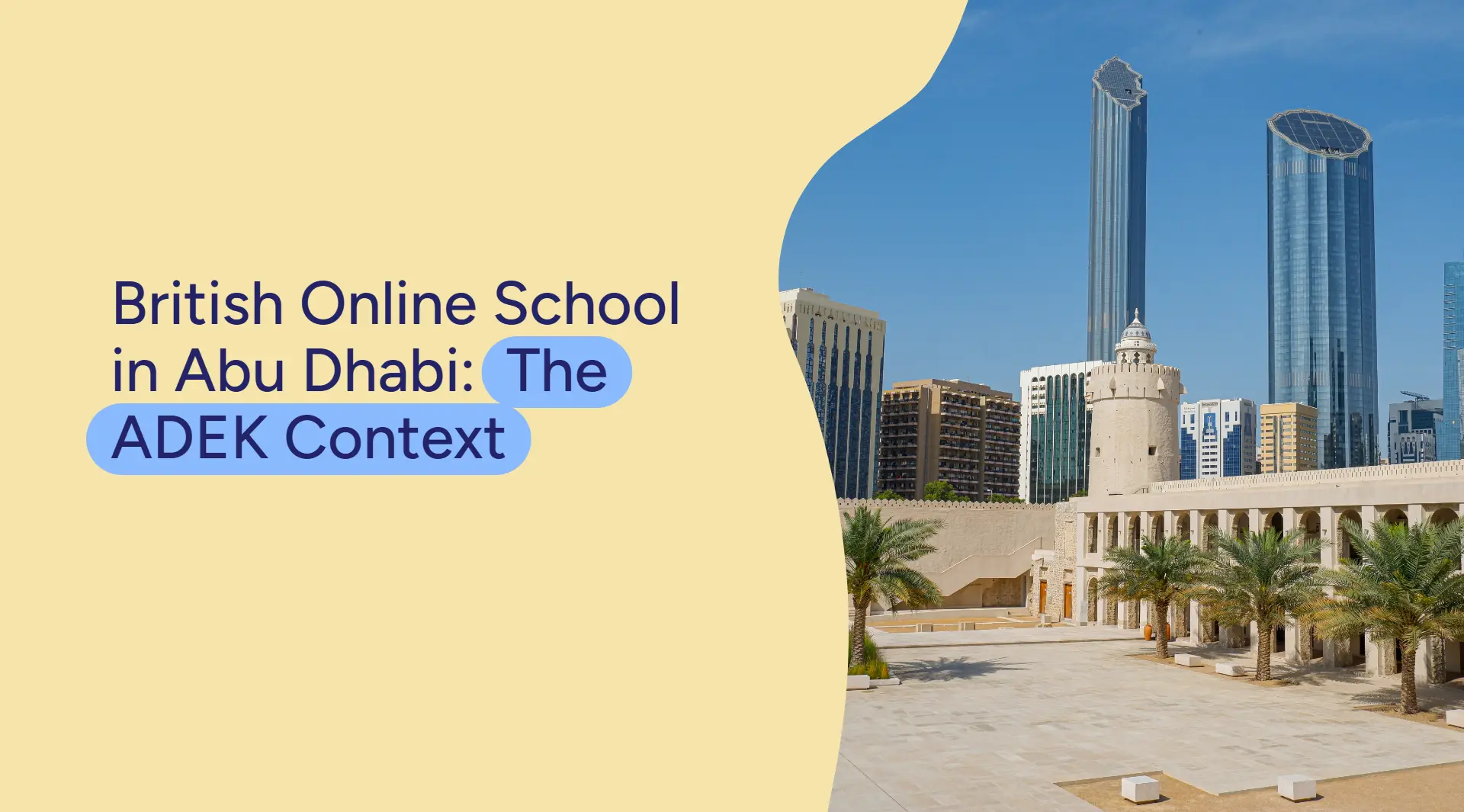
British Online School in Abu Dhabi: The ADEK Context
Abu Dhabi’s private schools are regulated by ADEK — the Department of Education and Knowledge — covering Abu Dhabi city, Al Ain and Al Dhafra. KHDA has no jurisdiction in the capital, and content written for Dubai families frequently gets this wrong. For online schooling the practical position is the same in both emirates: an accredited school based outside the UAE, teaching a child at home, falls outside ADEK licensing exactly as it falls outside KHDA’s, because licensing attaches to operating physically within the emirate. What differs in the capital is everything around that decision — fees that run above AED 71,000 at secondary, a smaller market with fewer centre options, and an American-versus-British choice that is genuinely open in Abu Dhabi city and considerably narrower in Al Ain.
Abu Dhabi's private schools are regulated by ADEK — the Department of Education and Knowledge — not by KHDA, which covers Dubai only. An overseas online school falls outside ADEK licensing in the same way it falls outside KHDA's, and private candidates sit Pearson Edexcel papers at Abu Dhabi examination centres.
Abu Dhabi is routinely treated as a footnote to Dubai in UAE education content, which doesn't serve families in the capital. The regulator is different, the school market is smaller and differently priced, and the examination logistics are tighter. Here is the capital-specific picture.
ADEK, not KHDA
The Department of Education and Knowledge (ADEK) regulates private schools in the Emirate of Abu Dhabi — which includes Abu Dhabi city, Al Ain and Al Dhafra.
ADEK's remit mirrors KHDA's within its own emirate:
Licensing private schools operating in Abu Dhabi
Inspecting them and publishing ratings — ADEK uses a band system, with Band A covering the strongest schools
Approving school fees and fee increases
Regulating teaching permits
KHDA has no jurisdiction in Abu Dhabi, and ADEK none in Dubai. Content written for Dubai families frequently gets this wrong, and a family in the capital reading a KHDA-framed guide is reading about a regulator that doesn't govern their schools.
For online schooling the practical position is the same in both emirates. An accredited online school based outside the UAE, teaching a child at home, falls outside ADEK licensing just as it falls outside KHDA's — because the licensing requirement attaches to operating a school physically within the emirate. Recognition of the qualification runs through the awarding body and, where local recognition is needed, Ministry of Education equivalency.
Full detail in the KHDA and online schools explainer, which covers the regulatory position across all emirates.
ADEK online school approval
There is no "ADEK-approved online school" category for an overseas provider, for the same reason there is no KHDA-approved one.
What ADEK approval means where it exists: a school licensed to operate physically in Abu Dhabi, inspected and rated by ADEK, with its fees approved by ADEK. That is a meaningful credential for a campus school in the capital, and ADEK ratings are worth consulting when comparing them.
What it does not mean: that an overseas online school is unregulated. The oversight sits elsewhere — with the awarding body, and with the regulatory framework of the country the school operates from.
For expatriate families, UAE compulsory-education law applies to Emirati nationals, so expat residents in Abu Dhabi are free to choose how their children are educated, including an accredited overseas online school. Emirati families should work through the Ministry of Education's distance-learning provision. Confirm your own position with ADEK or the MOE before deciding, since regulation is updated periodically.
Abu Dhabi school fees
The capital's British school market is smaller than Dubai's and priced slightly differently.
ADEK-approved fees, British School Al Khubairat (2025/26):
Nursery (FS1 core day) — AED 45,560
FS1 extended day to Reception — AED 51,410
Years 1 to 6 — AED 55,520
Years 7 to 9 — AED 71,810
Years 10 to 11 — AED 74,560
Years 12 to 13 — AED 74,560
Fees are payable across three terms. BSAK makes no additional charge for textbooks and materials, but external examination entry is explicitly the parent's responsibility — a cost worth noting, since it applies on top of a fee already above AED 74,000.
Other capital options: British International School Abu Dhabi starts around AED 55,000 at FS1 and is rated Band A 'Very Good' by ADEK, running a Nord Anglia collaboration with The Juilliard School.
Against this, an accredited online school at roughly AED 25,000 for a full A Level combination, or roughly AED 36,000 for eight International GCSE subjects, is a substantial gap at secondary level — on the order of AED 40,000 to AED 50,000 a year per child.
American vs British school in Abu Dhabi
A live question in the capital, where the American curriculum has a stronger presence than in Dubai.
The British route narrows progressively — broad at Key Stage 3, eight to ten subjects at International GCSE, three or four at A Level. Those final three or four grades are what universities assess. It is the most direct route into UK and Commonwealth universities, and is recognised everywhere else.
The American route keeps breadth to Grade 12, assessing through a GPA across many subjects plus SAT or ACT and, where taken, AP courses. It is the most natural route into US universities.
The practical question is destination. A family expecting their child to apply to UK universities is better served by A Levels; a family expecting US applications is better served by a diploma plus SAT and APs. Both routes reach both destinations, with more friction in each case.
A consideration specific to the capital: Abu Dhabi has strong options in both, so the choice is genuinely open rather than constrained by availability. That is less true in Al Ain and Al Dhafra, where the range is narrower — which is where an online route often becomes the practical way to access a British curriculum at all.
British online school in Al Ain
Al Ain has a smaller international school market than Abu Dhabi city, and families there face a narrower British curriculum choice.
What online schooling changes for Al Ain families:
Access to a full British curriculum without relocating or boarding
No daily commute into Abu Dhabi city
The same qualifications as a capital school
The examination consideration. Al Ain families typically travel to Abu Dhabi for examination series, since the British Council operates there rather than in Al Ain. Papers spread across several weeks, so this means repeated trips during the examination period rather than a single journey — worth planning for, including accommodation where papers fall on consecutive days.
Where Abu Dhabi students sit Edexcel papers
British Council Abu Dhabi accepts private candidates for Pearson Edexcel International GCSE and International AS and A Level, alongside Cambridge.
A number of Pearson-approved schools in the emirate also accept external candidates, though availability varies by year and subject and schools prioritise their own students.
Abu Dhabi has fewer centre options than Dubai, which makes early booking more important. Registration closes two to three months before each session, and late entry fees are steep — a unit at AED 535 at standard registration can reach AED 1,730 at the second late stage.
Important context: the May/June 2026 series was cancelled across all boards in the UAE because of regional instability, with grades awarded through contingency processes. Confirm the current series status directly before planning around it — see where to sit Edexcel exams in the UAE.
Frequently asked questions
Who regulates schools in Abu Dhabi?
ADEK — the Department of Education and Knowledge — regulates private schools across the Emirate of Abu Dhabi, including Abu Dhabi city, Al Ain and Al Dhafra. KHDA covers Dubai only and has no jurisdiction in the capital.
Is there such a thing as an ADEK-approved online school?
Not for an overseas provider. ADEK licenses schools operating physically in Abu Dhabi. An accredited online school based outside the UAE falls outside that framework, with oversight sitting with the awarding body and the regulator of the country the school operates from.
How much do British schools cost in Abu Dhabi?
At the established end, British School Al Khubairat's ADEK-approved fees run AED 71,810 for Years 7 to 9 and AED 74,560 for Years 10 to 13, with external examination entry charged separately. British International School Abu Dhabi starts around AED 55,000 at FS1.
Should we choose American or British curriculum in Abu Dhabi?
It depends on where your child is likely to apply to university. The British route narrows to three or four A Levels that UK and Commonwealth universities assess directly. The American route keeps breadth to Grade 12 with a GPA plus SAT or ACT, which suits US applications. Abu Dhabi has strong options in both.
Where do Abu Dhabi students sit Edexcel exams?
British Council Abu Dhabi accepts private candidates for Pearson Edexcel and Cambridge. Some Pearson-approved schools accept external candidates. The capital has fewer options than Dubai, so book early — and confirm current series status given the 2026 cancellations.
Is online school a good option in Al Ain?
Often, yes — Al Ain has a narrower British curriculum market than Abu Dhabi city, so an online school provides access without relocating or commuting. Factor in travel to Abu Dhabi for examination series, which spread across several weeks rather than a single day.
Abu Dhabi is ADEK territory, not KHDA, and an overseas online school sits outside both. Capital British school fees run above AED 71,000 at secondary, against roughly AED 25,000 to AED 36,000 for an online route. Examination centres are fewer than Dubai's, so book early. See how Teneo works.
Share