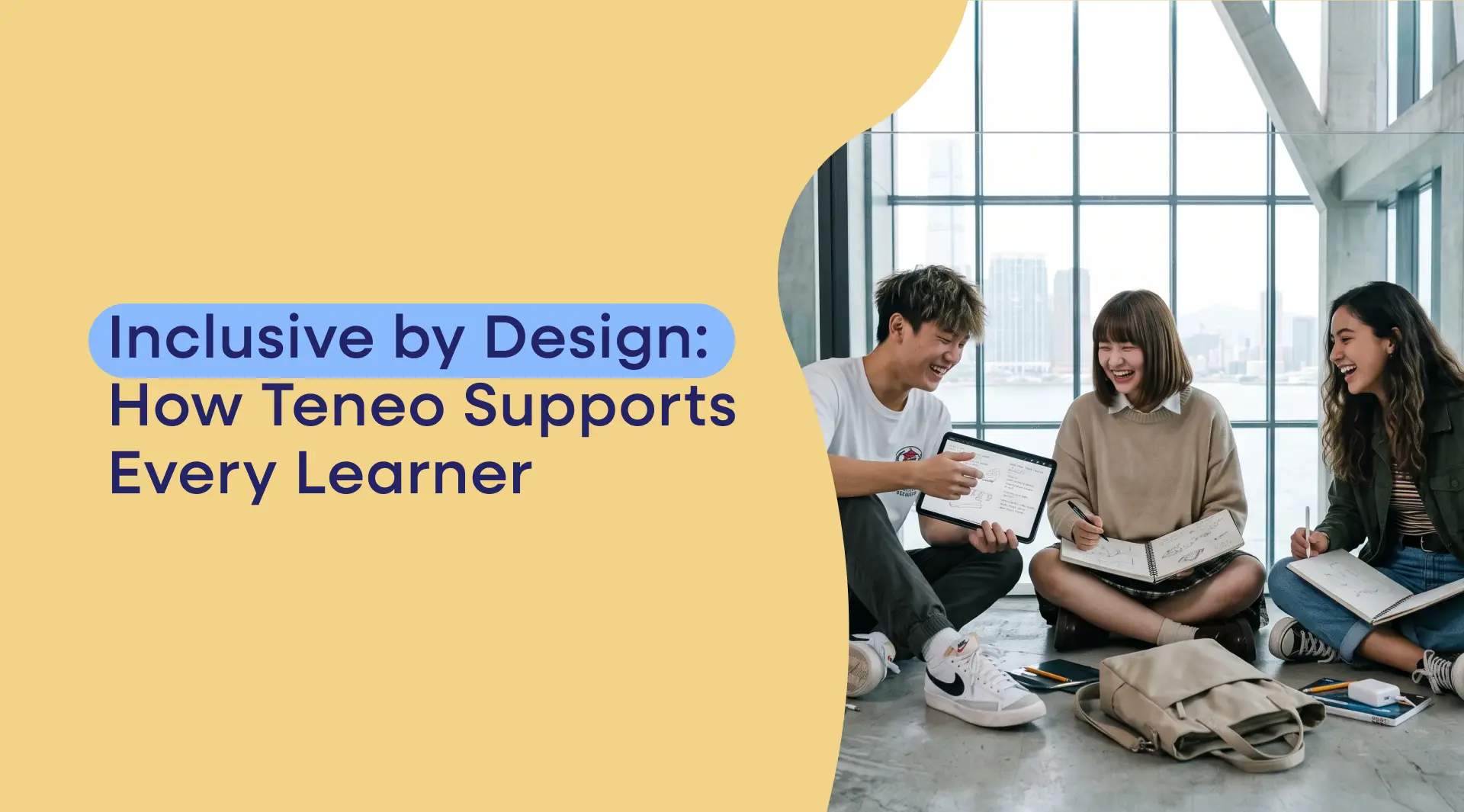
Inclusive by Design: How Teneo Supports Every Learner
Most schools are built for one kind of student and try to accommodate the rest. Teneo is designed the other way round: inclusive from the ground up, so that supporting a wide range of learners is not a bolt-on but the core of how the school works. This guide explains how — the model, the technology, the small classes, and the flexibility that together let one school support so many different children.
Teneo International School delivers the Pearson Edexcel British International pathway through its proprietary Smart School System™ and small live classes — one inclusive-by-design school built to support a wide range of learners, from anxious and neurodivergent children to gifted learners, athletes, performers and mobile families. The same model adapts to the individual child.
Most schools are built for one kind of student and try to accommodate the rest. Teneo is designed the other way round: inclusive from the ground up, so that supporting a wide range of learners is not a bolt-on but the core of how the school works. This guide explains how — the model, the technology, the small classes, and the flexibility that together let one school support so many different children.
How does Teneo support different learners?
Teneo supports different learners through a single, adaptable model rather than a patchwork of separate provisions — which is what "inclusive by design" actually means. At the centre are three things working together: the Pearson Edexcel British International curriculum (International GCSEs, AS and A Levels), delivered through small live classes by qualified specialist teachers, and underpinned by the Smart School System™, Teneo's own approach to tracking each learner's progress in real time and stepping in early where support is needed.
Why does this support such a range of learners? Because the same features meet very different needs. Small live classes mean every child is genuinely known, which helps an anxious child, a neurodivergent child and a child who simply needs more attention alike. Individual pace and recorded lessons help a child who needs to catch up and a gifted child who needs to race ahead. Flexibility around the timetable helps a young athlete, a child with a health condition, and a travelling family. One model, applied to each child's situation — that is how a single inclusive school supports learners who, at a traditional school, would need entirely different provisions. Read whether online school is right for your child.
An online school that supports every kind of learner
It is worth being concrete about the breadth, because "every kind of learner" can sound like marketing. In practice, Teneo's model is designed to work for learners who are usually served by very different kinds of school:
Anxious children and those who found a physical school overwhelming — helped by the calmer, home-based environment and being known in small classes.
Neurodivergent and SEN learners — helped by the calmer setting, individual pace, built-in accessibility, and coordinated learning support.
Gifted and high-ability learners — helped by the ability to be stretched and to work ahead rather than being held to a class's pace.
Athletes, performers and children with serious commitments — helped by flexibility and recorded lessons that fit education around training and performance.
Children with health conditions — helped by learning from home at a sustainable pace, with lessons to revisit.
Expat, military and globally mobile families — helped by an education that travels with them, keeping the curriculum and community constant.
The common thread is that these are not separate programmes; they are the same school, whose inherent features happen to meet each of these needs.
How Teneo adapts to individual learners
Inclusivity is not only about breadth across groups — it is about adapting to each individual child, and this is where the model does its real work. A few mechanisms make it concrete.
The Smart School System™ tracks each learner's engagement and progress, so teachers can see how an individual child is doing and step in early where they are slipping — turning "support" from something that waits for a crisis into something proactive and personalised. Small live classes mean teaching can be pitched closer to where each child actually is, and a child is a known individual rather than an anonymous face. Individual pace, with recorded lessons to revisit, lets each child move at a speed that suits them rather than a single class speed. And coordinated learning support means a child with additional needs has their needs understood and planned for, not left to chance.
Together, these mean the school flexes around the individual child — the fast learner extended, the anxious child supported, the child who missed a topic able to revisit it — within one coherent structure. That individual adaptability, at scale, is what "inclusive by design" delivers in practice.
Why choose Teneo for a child who needs support?
For a family whose child needs support of some kind, a few things distinguish an inclusive-by-design school from one that merely accommodates. First, support is built into the model rather than bolted on, so much of what a child needs — a calmer environment, individual attention, flexible pace, accessibility — comes as standard rather than as a special arrangement to be fought for. Second, the school is used to a wide range of learners, so a child with additional needs is who the school teaches every day, not an exception. Third, the Smart School System™ means a child is actively monitored and supported, so difficulties are caught early rather than after a child has fallen behind.
There is also an honesty that a good inclusive school should offer: it will tell you frankly whether it can meet your child's needs well, rather than promising to support every need regardless. Inclusivity does not mean claiming to be right for every child in every circumstance — a child with very complex or specialist needs may require specialist provision. It means being genuinely built to support a wide range of learners well, and being honest about the edges. That combination — broad, built-in support plus honesty about fit — is what makes it a serious option for a child who needs support.
Is Teneo good for children with additional needs?
For many children with additional needs, yes — and the reasons follow directly from the inclusive-by-design model. The calmer, home-based environment removes much of the sensory and social overload that makes a physical school hard for many neurodivergent and anxious children. Small live classes mean a child is known and supported rather than lost in a crowd. Individual pace and rewatchable recorded lessons suit children who process differently or need more time. Built-in accessibility tools support a range of needs as standard. And coordinated learning support means a child's needs are understood and planned for. Teneo's admissions are open and inclusive of neurodiverse learners, reflecting that this is who the school is built to teach, not an afterthought.
As with any school, the honest position is that it is not automatically right for every child with every need — the fit depends on the individual child, and a specialist placement is sometimes necessary for very complex needs. The right way to find out is a candid conversation with the school about your specific child. But for a great many children with additional needs, an inclusive-by-design online school is genuinely well suited — often better suited than the mainstream setting they struggled in.
Frequently asked questions
How does Teneo support different learners?
Through one inclusive-by-design model: the Pearson Edexcel curriculum delivered in small live classes by specialist teachers, underpinned by the Smart School System™ that tracks each learner and supports them early. The same features — small classes, individual pace, flexibility, coordinated support — meet many different needs, so one school supports learners who would traditionally need separate provisions.
Does Teneo really support every kind of learner?
It is built to support a wide range — anxious and neurodivergent children, gifted learners, athletes and performers, children with health conditions, and mobile families — because its inherent features meet each of these needs. Honestly, no school suits every child in every circumstance; a very complex need may require specialist provision, and a good school says so.
How does Teneo adapt to an individual child?
The Smart School System™ tracks each learner's progress so support is proactive and personalised; small live classes let teaching be pitched to where a child is; individual pace and recorded lessons let each child move at a suitable speed; and coordinated learning support plans for a child's specific needs. The model flexes around the individual within one structure.
Why choose Teneo for a child who needs support?
Because support is built into the model rather than bolted on, the school teaches a wide range of learners every day, and the Smart School System™ catches difficulties early. A good inclusive school also tells you honestly whether it can meet your child's needs, rather than promising to support every need regardless — which is the right basis for the decision.
Is Teneo good for children with additional needs?
For many, yes — the calmer environment, small classes, individual pace, built-in accessibility and coordinated support suit a range of neurodivergent, anxious and other additional needs, and admissions are inclusive of neurodiverse learners. Fit depends on the individual child, and very complex needs may require specialist provision, so a candid conversation with the school is the right next step.
Share